While AI can redefine business, most initiatives fail to deliver ROI. Discover why the shift from "deterministic" to "probabilistic" systems is the key to scaling AI successfully.
Introduction
AI has the potential to redefine how organizations operate driving efficiency, unlocking new capabilities, and accelerating decision-making.
Yet most AI initiatives fail to deliver meaningful ROI. In some cases, they introduce new risks operational, reputational, and legal.
The issue isn’t ambition. It’s execution.
The Core Problem: AI Doesn’t Behave Like Traditional Technology
Traditional systems are deterministic:
- Same input → same output
- Highly reliable and predictable

AI is different.
AI is probabilistic:
- Flexible and adaptive
- Capable of solving complex, previously unaddressable problems
- But inherently capable of producing incorrect results (“hallucinations”)
These errors are not exceptions, they are expected behavior.

Why AI ROI Breaks Down
Two factors drive most failures:
1. Training Data Misalignment
The further a request is from the model’s training data, the higher the error rate.
2. Compounding Errors
Modern AI solutions chain multiple steps together.
Even modest error rates compound quickly:
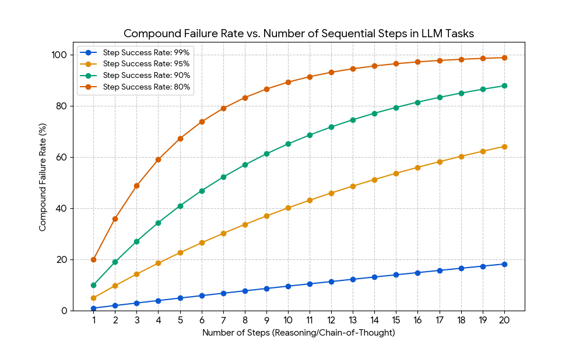
This is the most common reason AI initiatives fail at scale.
What Successful AI Implementations Do Differently
Winning organizations don’t rely on better models, they build better systems.
1. Automated Validation (Foundation)
Systematically verify outputs at every step:
- Schema validation (e.g., JSON)
- Static and dynamic data checks
- Cross-model comparisons
Failed outputs are automatically retried or escalated.
2. Human-in-the-Loop (Precision Layer)
Use human validation where accuracy is critical:
- Highest reliability
- Higher cost must be factored into ROI
Key benefit: generates high-quality training data for continuous improvement.
3. Context Engineering (Relevance Control)
Provide the model with targeted, relevant information.
Common approach: RAG (Retrieval-Augmented Generation)
Tradeoffs:
- Infrastructure and maintenance overhead
- Increased token costs
- Performance degradation if prompts become too large
Best practice:
- Inject only necessary data
- Use structured retrieval logic
- Leverage high-quality examples from validated outputs
4. Model Fine-Tuning (Long-Term Advantage)
Improve accuracy by aligning the model to your domain.
Approaches:
- Operational data capture (especially human-corrected outputs)
- Synthetic data generation based on business rules
Result: a specialized model with significantly reduced error rates.
The Bottom Line
AI success is not about deploying a model.
It’s about engineering a system that:
- Controls error rates
- Validates outputs
- Learns continuously
Organizations that do this achieve scalable ROI.
Those that don’t remain stuck in pilots.
The Shift That Matters
The future of AI will not be defined by model capability alone.
It will be defined by the systems built around it:
- Validation
- Context
- Data
- Control
That’s where real competitive advantage is created.